
What Does Binary Mean?
by TM Garret Schmid
January 11, 2026
We live in a world where people have a hard time figuring out why we are here, what we’re supposed to do, and how everything works. Where are we going when we’re dead? Basically, how anything functions. These are the things I can’t not think about, and it’s what my brain keeps circling back to, whether I want it to or not.
The Questions That Won’t Let Go
A few years ago, I concluded that we live in a binary world. Actually, a binary universe. When I say binary, I mean this: in my model, beneath our stories everything reduces to a two-state distinction. It only becomes complicated when those states get tangled up. It feels like an eternal dualism running like a red thread through everything we know. Morals, computers, neurology. Layered up like an onion until we can’t see the core. The same binary code, stacked, nested, and translated across layers. Beneath these layers, it unraveled for me and made it easier to understand the meaning of life, why we’re here, and why things work the way they do. Our soul, the life after death, everything.
When I had this Eureka moment it felt like I found the Holy Grail. Triumphant. But at the same time, I was afraid of being perceived as grandiose or arrogant, just because I think I figured it out. Yes, that’s how it felt: I figured the universe out, how everything works, and it’s so simple. And don’t get me wrong. I am not claiming that I am right and everybody else got it wrong. I am simply philosophizing and it’s just my perception. I may be wrong, but it works for me. Like I said, my brain works differently.
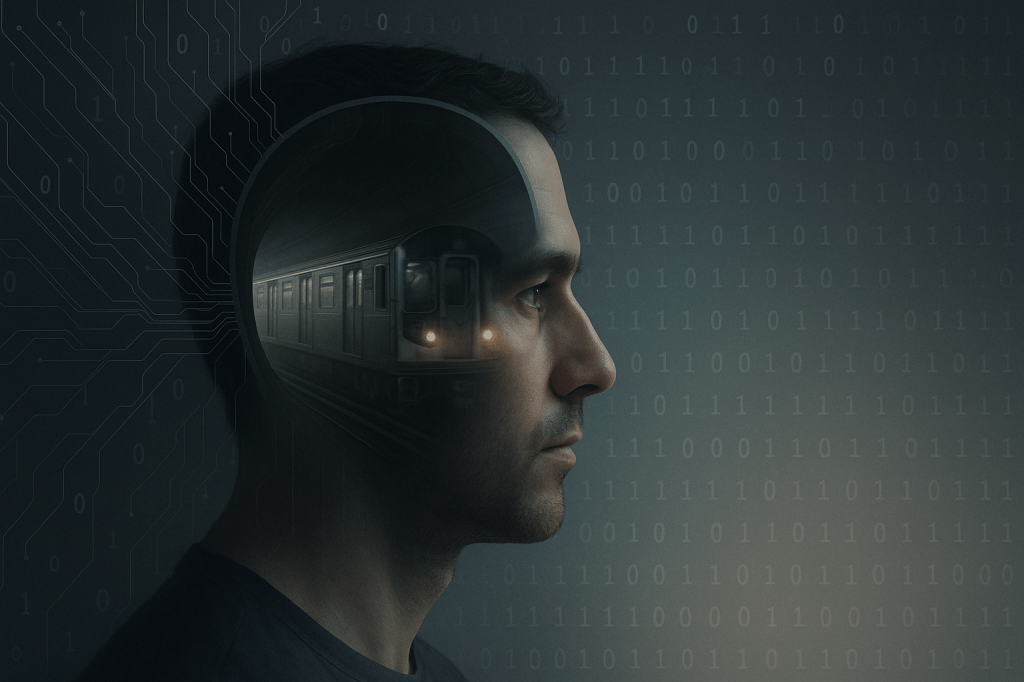
I like to simplify things. Not because my brain can’t comprehend things, it’s rather the opposite. My brain is traveling like a train at high speed on six tracks at the same time. All the time. I’m a neurodivergent, probably undiagnosed with ADHD. Maybe I need the extra room that keeping it simple creates for the extended thinking.
My Hyperactivity is Upstairs
Until a few years I simply thought “I talk a lot”, without having an explanation. Then I figured I may have at least ADD but hadn’t fully acknowledged that it’s probably undiagnosed ADHD. My therapist said once that there is no ADD, it’s all ADHD. And he’s right. It’s just that the stigma in the hyperactivity part makes people think of children that can’t sit still. And especially grown men don’t want to be compared to restless children, who are fidgety, can’t sit still, running around. And indeed, this is not even how my ADHD works. My hyperactivity is upstairs. It’s in my head. This is not a strange personality quirk. It’s the lens everything gets filtered through.
Thinking Nothing
While other people sometimes say they think nothing, whether this means they come to an end of their thought and then fill themselves up with external clutter, or because externalizing their thoughts is exhausting to them, I don’t know.
But I would look at the popcorn ceiling, and it carries me away about the patterns, and suddenly I think about the deeper meaning of life. Or I will look outside at the birds and suddenly I will think about how they live their parallel life up there, they’re seeing us and we’re seeing them, yet it is not touching each other. I just can’t shut off. And it doesn’t bother me. Of course, my mouth can’t shut off either. That is a product of it. And some perceive it as if I like to hear myself talk, or I make everything about myself. That’s absolutely not the case. I just can’t help it.
I’m a verbal processor and I have the best ideas when I put things out verbally or in writing. The best findings, realizations, recognitions, and Eureka moments. That’s one of the reasons why I built a searchable AI journal that also keeps all these verbal processing and a brain fart list, so I don’t forget thoughts that might be meaningful. someday.
Life then forced me to apply all of this to something I didn’t want to lose, which is where this stops being theory.
After coming out of a divorce that I never wanted, I tried to figure out why I am the way I am. Working on myself in therapy helped. Journaling and verbal processing helped. And also asking myself the question of how different people communicate, what problems this causes, and what the explanation might be, without necessarily having a conclusion or solution.
I have one in my head, but that doesn’t mean it works and everybody can implement it. What I kept running into, over and over, was that people don’t fight about facts first, they fight about meaning. And meaning is influenced by our perception. Our very own subjective truth.
And that’s why humans often do things that seem to be wrong to other people, but to themselves it’s right and just.
And we sometimes think people do or say things on purpose to hurt us, or for some other reason. That is mostly not even the case.
Often people don’t realize what they’re doing. They’re not aware of the difference between intent and impact, and how different language distorts meaning. It is a little bit like the societal belief that men think different than women. That might be partially true because we are definitely wired differently, but it’s also a big gap between different brain types, especially neurotypical and neurodivergent humans.
Neurotypical is “default wiring,” the majority setting, the brain most systems were built for. But being neurodivergent doesn’t mean being broken. It’s just different wiring, and a lot of the chaos comes from the fact that we process the input differently and often express it differently too. Once you see that difference, you start wondering what’s underneath it. It’s literally a rabbit hole.
When I started to believe in this cosmic balance of positive and negative, good and bad, zeros and ones, yin and yang, and I was convinced that we cannot change this balance, that the amount of these particles, cells, or energy is supposed to be always the same and shouldn’t be brought out of balance, or maybe even can’t be, I discovered the concept of the binary world.
Do We Live in A Simulation?
There are even indicators that point in the direction that we live in a simulation, including the fact that our technology runs on binary code. Who says God isn’t a teenage gamer named Jeff wearing a Minecraft t-shirt and Bermuda shorts, coordinating his Sims?
I am not trying to prove this here or make it the point of this particular essay, but notable astrophysicists like Neal deGrasse Tyson, Brian Cox and last but not least Stephen Hawking can’t rule out we live a giant computer. Melvin Vopson’s recent paper asked: “Is gravity evidence of a computational universe?” But maybe I’m putting the cart before the horse, and we are just creating computers that way because that’s how the universe works. Or maybe the universe works that way because it is a computer. Who knows?
But since my brain just works like that, it carried me further and I thought: if the universe works like that and everything works like that, our brains must work like that as well.
And if we all think in binary code, which makes sense because it’s the neurons and they only have two states, either they fire or they don’t, that is 1 and 0. It is a little bit misleading because the 0 doesn’t mean it doesn’t have a value. Zero is actually the value that it doesn’t fire.
You may say there’s a third state, which is the neutral state, which is neither 1 nor 0. And maybe binary code should have been 1 and -1. In science and mathematics, 0 doesn’t have a value and represents neutrality. And I think this misconception keeps people from actually seeing the pattern.
Maybe the brain doesn’t think in language first. Maybe it thinks in signals, and language is the afterthought.
First, the brain gives a signal, like Morse code, like electricity: fire or not fire. In patterns, that gets interpreted like a computer program. Starting with amoebas like a simple IF THEN syntax in BASIC (a programming language), up to more complex beings with more complex programs, ending up with humans.
Language Is the Translator
So, I wonder: if we were telepathic, would we still transfer our thoughts in language, or would it be code? Well, it is still wishful thinking to be able to read each other’s thoughts.
At this point we have to verbalize them to communicate with each other, and for that the frontal cortex has a translator that puts those thoughts into words. But sometimes that is not as easy as it sounds. We all know how hard it is sometimes to put our thoughts into words when we can’t explain something that we feel, or that we know, or that we have done, or know how to do, and we just can’t explain it. We just can’t help it.
This is where I believe nonverbal autistic humans are. They are highly functioning and their brain is going 90 mph, and they have no way to verbalize their thoughts. It feels like their translator is broken.
We think that they only think in black and white, and like in binary, and “normal” people don’t.
I believe this is false. I believe we all think in binary, and the only part in the brain that is a mismatch is in the frontal cortex, that translator that connects us. That translator that makes us feel that we operate on the same frequency when it works and everything matches but feels like the other person is speaking a different language when it seems broken.
Maybe the translator isn’t broken. Perhaps it’s just the software that needs an update.
NEXT: THE BINARY CODE PART II: A Relationship is Not a Courtroom
To Part I
Thoughts, criticism, or just want to learn more? E-Mail me at official.tmgarret@gmail.com – I’d love to hear from you.
 CHOOSE HUMANITY ANYWAY