
A Relationship is Not a Courtroom
by TM Garret Schmid
January 20, 2026
DISCLAIMER: A lot of the scenarios in this part happen in many neurotypical relationships. But neurodivergence is often extra fuel in the fire, especially when undetected.
“You are always trying to pull some proof that you have on your phone. You are a control freak.”
I remember those words clearly, not because they were poetic, but because they landed like a verdict, and the person in front of me felt like a judge.
And the weird part is this: I was not even trying to prove I was right for sport. I was trying to justify myself. And that is a difference.
Sometimes people call it overexplaining. Sometimes it is “you always have to prove things.” Other times it is “why do you even need receipts?” But what if the other side does not believe what you remember? What if your memory is treated like a lie? What if the emotional story is already written, and you are just the villain that needs a motive?
So yes, I pulled up photos. I pulled up notes. I pulled up timestamps. Not to win. To be heard. Because I felt judged and sentenced without a trial. I felt like, in the moment, if I could not produce evidence, I would lose the right to exist in the conversation.
The Translator Enters the Room
This is where the binary code stops being theory. The neurons are either firing or not firing, and the “translator” turns raw signals into language. The zeros and the ones are there, but the translator that puts them into words seems to be broken. And sometimes you stand there and feel like, “I don’t want to be like this right now,” or “I don’t want to keep pushing, but I can’t help it.”
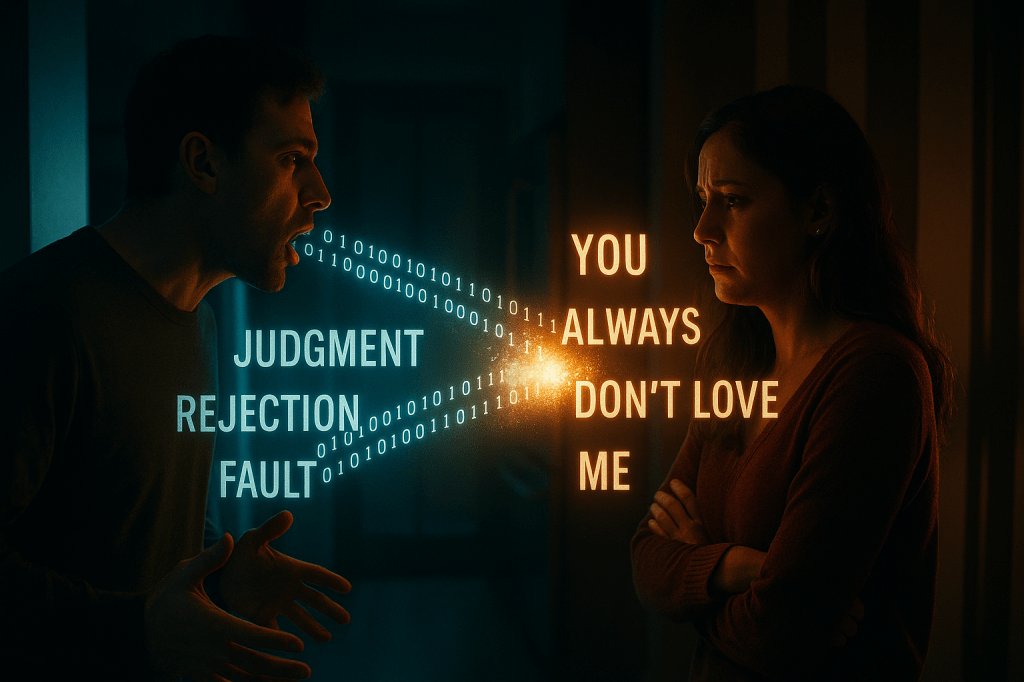
Humans rarely fight about facts first. They more often fight about meaning. And that meaning feels very personal. When you are not being heard, it becomes even more personal.
Even though a relationship is not a courtroom, when you combine neurodivergence with old trauma triggers, it can start to feel like one anyway. And once it feels like one, everybody shows up in a role. Prosecutor. Defense attorney. Witness. Judge.
It feels very binary, because it seems there is only right and wrong, and each side needs to fulfill a role. So both sides are performing the roles simultaneously, fighting for who is which. You can’t be both at the same time. Can you?
And now imagine children in the room. Little souls that learn very quickly that love can feel conditional on performance.
A common pattern that shows up again and again in neurodivergent relationship conversations is when one partner becomes the project manager, and the other becomes the “I will do it later” partner, even if both care. The manager keeps the household running. The other one keeps trying, failing, forgetting, getting overwhelmed, and promising. And then the manager turns into a human reminder app, which creates resentment.
Add trauma triggers and it gets worse, because reminders can feel like control, and shutdown can feel like abandonment. The manager thinks: If I do not push, nothing happens. The other person thinks: If you push, I cannot breathe.
Verbal Processing vs Safety
When one side keeps talking, it may feel even more like it takes the other person’s air to breathe. And that’s what I do. I process out loud. It is how I think, how I clarify, and how I find my own truth. I am a verbal processor. My mouth seemingly can’t shut off. Not because I love hearing myself talk, but because my thoughts do not become clear until they are external. That is also why I write.
So, in the past, I would talk. I would explain in an attempt to connect dots and give context, trying to be precise. But a partner, romantic, business, or just a friend, could experience that as intensity, interrogation, or criticism. Not because I meant it that way, but because the translator on their side heard threat where I meant clarity.
When you add trauma to this difficult scenario, this intensity can flip someone’s nervous system into action: fight, flight, or freeze.
Their eyes change. Their tone goes flat. Their words get short. Or they fire back. And when that happens, my brain does what it has always done. It tries harder. It pushes. It goes into overdrive, because I cannot stand the feeling of being misunderstood and dismissed.
Or they try to shut down and remove themselves from the situation. But for a neurodivergent brain, this can feel like abandonment, and the person trying to remove themselves can feel “not safe.” How can I trust the issue is getting resolved if they keep running away from it? So we better solve it now and restore harmony.
So, the more they shut down to feel safe, the neurodivergent and anxious me talks and pushes to feel safe. Two safety strategies colliding.
I did not know any of this at the time. I just knew I felt accused. And when I felt accused, I started building a defense file in real time. Photos. Notes. Exact wording. Dates. Anything that could stop the sentencing.
Perpetrator and Victim at the Same Time
There is a specific kind of pain that happens when someone responds flat, delays, forgets, or disengages. For a neurotypical person, it might be much easier to read it as neutral. But for an ADHD brain or someone on the autism spectrum, it can read it as rejection, especially when they do not know the reasoning behind the action.
Even an “I am too tired to keep talking” starts to feel like rejection.
The nervous system escalates, not because it wants a fight, but because it wants the uncertainty to stop. It wants the fog to clear. It wants to be safe.
If you have ever been there, you know what comes next, even when neither you nor the other partner is neurodivergent. You ask again. You explain again. You bring the evidence again. You try to lock the other person into a clear answer. And if you have been there, you also know that it won’t work. The other person experiences that escalation as attack. They pull away more. They shut down more. They disengage more. And that proves the rejection story in your head.
Now the loop is closed. The story becomes self-fulfilling.
If you are the one escalating, you feel abandoned. If you are the one withdrawing, you feel controlled. Both people feel unsafe. Both become perpetrator and victim at the same time.
And this is why a home can turn into a courtroom. Both sides are fighting for psychological oxygen. And this doesn’t happen because anyone is evil. It happens because the nervous system crosses a threshold. And once one person is not getting heard, and thinks that getting louder will make a difference, they really push the other person away. The other person feels attacked, becomes defensive, withdraws, and a vicious cycle starts. A cycle that is often the beginning of the end.
Breaking The Cycle
But the cycle can be broken. Because sometimes the problem is not love. The love is often there. The problem is translation from binary to human language. Two nervous systems reading the same zeros and ones, but hearing two different stories.
Sometimes it is possible to break this cycle before it becomes “unfixable,” especially if the neurodivergent part is detected early enough and can be considered as a factor, understood by one side, and treated by the other side. But sometimes all you can do is clean up the remains from the fire of a conflict that has burned down your relationship and left nothing but sad ashes.
But it is never too late to turn inward and look for the reasons why it always comes to this point. It is never too little when you decide to work on yourself. Sometimes baby steps are better than staying stuck. It means you are moving forward to your own healing.
NEXT: THE BINARY CODE PART III – tba
Thoughts, criticism, or just want to learn more? E-Mail me at official.tmgarret@gmail.com – I’d love to hear from you.
 CHOOSE HUMANITY ANYWAY